
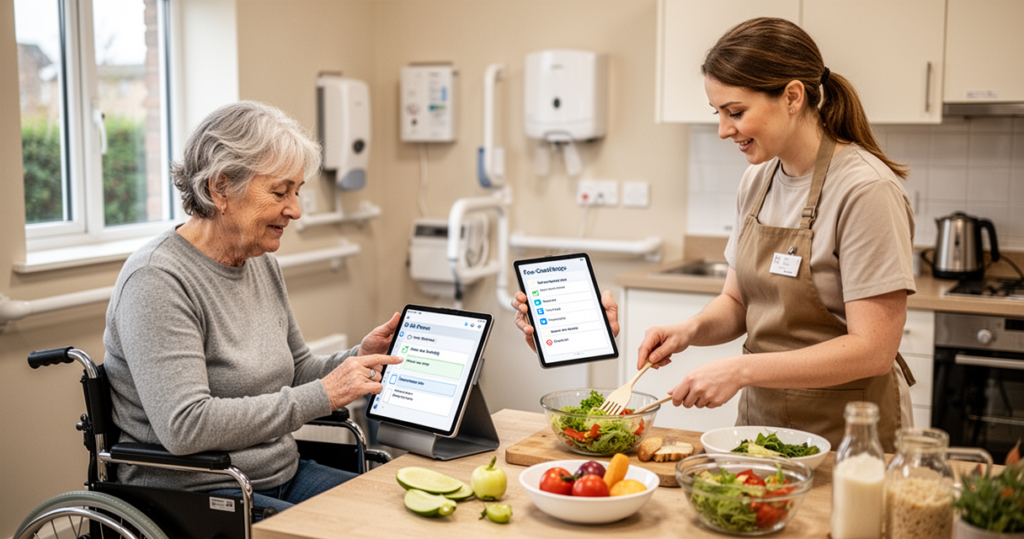
Afford supports participants with disabilities to build practical skills and strengthen capacity so daily life feels more manageable and more independent.
This work is not only about learning a task once. It is about building routines, confidence, and the ability to make choices and keep improving over time.
A useful way to understand Afford’s approach is to think in terms of the steps required for employee skill development. The same skill-building logic applies to participants working toward personal goals like cooking safely, using transport, communicating needs, or preparing for work.
This article explains how Afford can help participants improve skills and capacity, how progress can be tracked, and how to choose training methods that fit different learning styles and support needs.
What skill and capacity building looks like with Afford
Skill development is about learning specific actions and doing them more consistently. Capacity building is broader. It is the ability to apply skills in different settings, solve problems when something changes, and ask for the right support when needed.
Afford programs commonly focus on everyday independence, communication, social participation, and work readiness. Progress often happens through small, repeated steps and supportive coaching.
A strong program keeps goals realistic and personal. The aim is not perfection. The aim is steady improvement that carries into real life.
- Choosing participant-led goals that matter day to day
- Breaking skills into small, teachable steps
- Practicing in real settings, not only in a classroom
- Building confidence to try again after mistakes
- Planning supports that reduce over-reliance over time
A practical framework: steps required for employee skill development (applied to participants)
Even though participants are not always employees, a structured development cycle is still helpful. The steps required for employee skill development can be adapted to build independence skills, social skills, and vocational skills.
A clear process helps everyone stay aligned, including the participant, support workers, family members (when appropriate), and allied health professionals (when involved). It also reduces frustration by making expectations visible and measurable.
- Step 1: Identify the goal and the reason it matters to the participant
- Step 2: Assess the current level and what support is needed
- Step 3: Pick the right training approach and environment
- Step 4: Practice regularly with feedback and coaching
- Step 5: Generalise the skill to new places and people
- Step 6: Review progress and adjust supports and goals
On-the-job and off-the-job training techniques that build real independence
Participants often learn best when training matches the situation where the skill will be used. That is why combining on the job and off the job training techniques can work well.
Off-the-job and on-the-job training methods can be blended. For example, a participant might first practice communication scripts or safety steps in a calm space, then try the same skills in a busier real-world setting with support.
- Off-the-job practice for new or anxiety-triggering skills
- On-the-job practice for real-life pacing and problem-solving
- Short sessions that repeat across the week to build memory
- Role-play for requests, boundaries, and workplace conversations
- Checklists and visual prompts to reduce cognitive load
- Related: [Internal Link Placeholder]
How Afford can support soft skills and self direction
Many independence outcomes rely on soft skills. These include communication, teamwork, emotional regulation, time management, and confidence to advocate for support.
It also helps to build self direction. If you have asked, why is self direction a valuable skill, it is because it supports long-term independence. A self-directed person can set goals, notice what is not working, and ask for adjustments without waiting for someone else to take the lead.
Afford-style support often strengthens self direction by giving participants safe choices, predictable routines, and opportunities to reflect on progress.
- Practicing decision-making with real consequences and safe support
- Learning how to ask for help clearly and respectfully
- Building routines for attendance, punctuality, and task completion
- Using simple goal tracking that the participant can understand
- Related: [Internal Link Placeholder]
How to measure soft skills development without overcomplicating it
Measuring progress makes training more effective. It also helps participants feel motivated because improvement becomes visible.
If you are looking for how to measure soft skills development, keep it simple and consistent. Choose a few behaviours that show the skill in action, then track them over time in different settings.
Measurement should be supportive, not judgmental. The goal is to learn what helps the participant succeed and what barriers still need to be addressed.
- Use a simple rating scale for confidence or independence (for example, needs full support to independent)
- Track frequency (how often a behaviour happens) and quality (how well it goes)
- Collect examples from multiple settings, not just one session
- Combine participant self-reflection with supporter observation notes
- Review progress at set times and update the plan
Using observation on the job training to make learning stick
Observation on the job training is especially useful for skills that are hard to explain in theory, like navigating social cues, following a workflow, or staying safe in a busy environment.
A supporter can watch for small moments that matter. For example, whether the participant notices a change in routine, asks a clarifying question, or uses a coping strategy when stressed.
The key is respectful feedback. Feedback should be timely, specific, and focused on behaviours the participant can change.
- Observe one or two priority behaviours per session
- Give feedback quickly using clear, concrete language
- Practice the same task again while the coaching is fresh
- Fade prompts gradually to build independence
- Document what worked so it can be repeated
A note on specialised manuals and technical training terms
You may come across training terms and manuals in broader training environments, including orp training, multi directional training, cirrus training manual, and directional drilling training manual. These labels often relate to specific industries, equipment, or structured learning systems.
In disability support and capacity building, the takeaway is not the manual itself. The takeaway is the idea of structured instruction: clear steps, consistent practice, and safety-focused supervision.
If a participant is entering a particular workplace or training environment, always confirm which materials are required and who is authorised to deliver or assess that training.
- Use structured instructions and repeatable routines
- Keep safety and consent central to any training plan
- Check official workplace or provider requirements before using any manual
- Translate technical instructions into accessible formats when needed
- Related: [Internal Link Placeholder]
Frequently Asked Questions
Skill building is learning a specific task. Capacity building is being able to use skills across situations, make choices, and keep improving with less support.
Self direction helps a person set goals, make decisions, and ask for the right support. It supports long-term independence.
Off-the-job can include role-play and step-by-step practice in a calm space. On-the-job includes supported practice in real settings with feedback.
Pick a few observable behaviours, use a consistent rating scale, and track progress across different settings over time.
It allows supporters to coach in real moments, reinforce good choices, and adjust supports based on what actually happens in the environment.
Only if they are entering a setting that requires that specific training. Always confirm requirements and who is qualified to deliver it.